
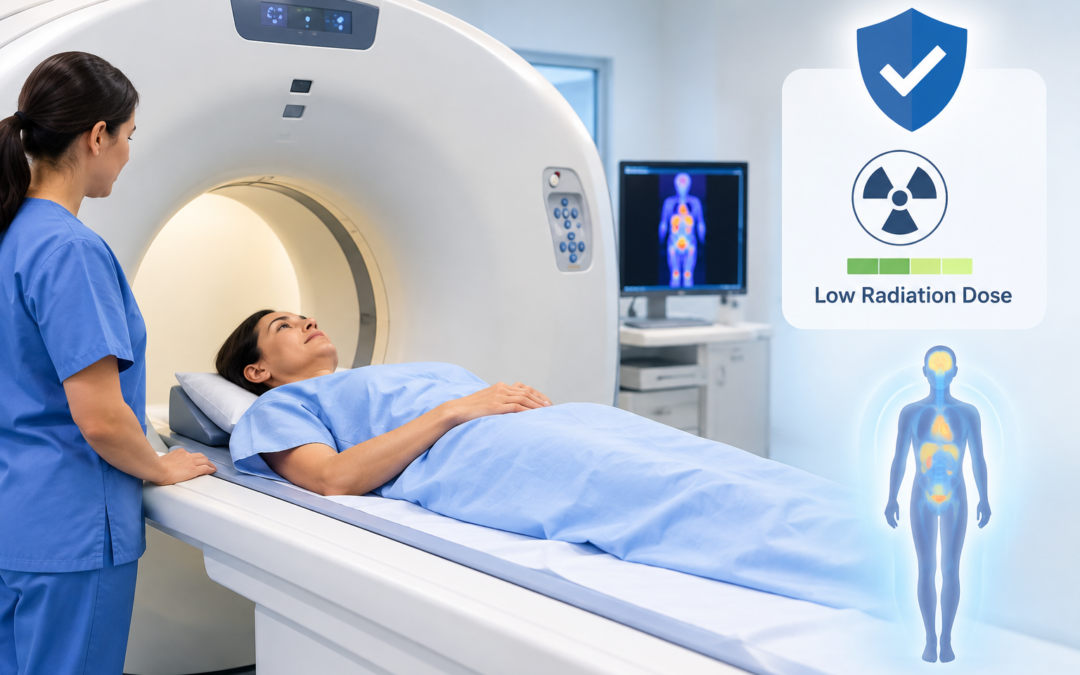
yes, for most people. A PET scan does use a radioactive tracer, so there’s a real dose involved, not just a theoretical one. But put next to what we’re exposed to naturally every year just from sunlight and the ground beneath us, it’s a small, well understood amount. Doctors don’t hand it out casually either. If your scan has been ordered, it’s usually because finding out what’s actually going on (cancer, infection, something else entirely) matters more than the small risk associated with radiation exposure.
“Patients often assume any radiation is dangerous by default,” says Dr. Gayana Shankaramurthy,an expert Nuclear Medicine Specialist “A PET scan uses a carefully calculated dose that’s been studied for decades now. We weigh the benefit against the exposure every single time before recommending one, and for the large majority of patients, that balance isn’t close.”
Is a PET Scan Safe? What the Radiation Dose Actually Means?
Numbers help more than reassurance here, so let’s put them side by side.
|
Source |
Typical Radiation Dose |
|
Whole-body PET/CT scan |
Roughly 10 to 25 mSv (varies by protocol and scanner) |
|
Standard chest X-ray |
About 0.1 mSv |
|
Standard CT scan (abdomen) |
About 2 to 10 mSv |
|
Natural background radiation (per year) |
About 3 mSv |
So yes, a PET scan sits well above what you’d pick up from background radiation in a year. That’s not an accident. It’s why the scan gets reserved for cases where the result can help guide diagnosis or management , not ordered on a whim. One thing that surprises a lot of patients: most of the dose comes from the CT part of the combined exam, not the tracer. Worth knowing more about how PET/CT (Oncological & Non-Oncological) imaging is dosed for each patient rather than applied as a flat number.
Got a PET scan coming up and want the radiation part explained without the jargon?
Who Should Be Extra Cautious About PET Scan Radiation?
-
Not every patient carries the same level of risk, and a few groups deserve a more careful conversation before booking.
Pregnant patients usually skip PET scans unless there’s no reasonable alternative and the information is genuinely necessary. It’s a case-by-case call, not a blanket rule.
Breastfeeding? You’ll likely be asked to pause for a short window after the injection, since a small amount of tracer can pass into breast milk.
Kids get lower doses, adjusted for their size, and PET scans in children tend to be reserved for cases where the answer is really needed. Younger bodies are more sensitive to radiation over a longer lifetime, so the bar is higher.
And if you’re facing repeated scans (which happens a lot during cancer treatment monitoring) the cumulative dose becomes part of the conversation too. Each additional scan gets weighed against whether it will actually change the treatment plan, not scheduled automatically.
Curious what the scan is even picking up in the first place? It’s worth reading about what a whole-body PET scan detects before getting into the radiation math.
Why Choose Dr. Gayana Shankaramurthy for a PET Scan?
Dr. Gayana Shankaramurthy has 12 years of experience in nuclear medicine and has interpreted more than 40,000 PET/CT scans. She currently serves as Director, Nuclear Medicine and Theranostics at KIMS Hospitals, Bengaluru. ,. She holds an MD in Nuclear Medicine from PGIMER Chandigarh, along with FEBNM (Barcelona) and MICNM credentials, and has presented research at SNMMI (USA) and EANM (Europe). Her approach pairs precise scan interpretation with clear communication, which can be particularly helpful for patients undergoing the test for the first time. Call 7483160232.
Frequently Asked Questions
Does a PET scan increase cancer risk?
Slightly, but the added risk is small next to the diagnostic benefit.
How long does the radiation stay in the body?
Most of it clears out within a few hours.
Can I be around family after a PET scan?
Yes, just keep some distance from young kids and pregnant people briefly.
Is PET scan radiation different from X-ray radiation?
Both are ionizing radiation, but PET also involves an internal tracer.
References:
- Hosono M, Takenaka M, Monzen H, Tamura M, Kudo M, Nishimura Y. Cumulative radiation doses from recurrent PET-CT examinations. National Institutes of Health, PMC. https://pmc.ncbi.nlm.nih.gov/articles/PMC9328066/
- Patient effective dose for different PET/CT procedures with various radiopharmaceutical compounds. National Institutes of Health, PMC. https://pmc.ncbi.nlm.nih.gov/articles/PMC5403773
Disclaimer:This blog is for educational purposes only and isn’t a substitute for professional medical advice.