
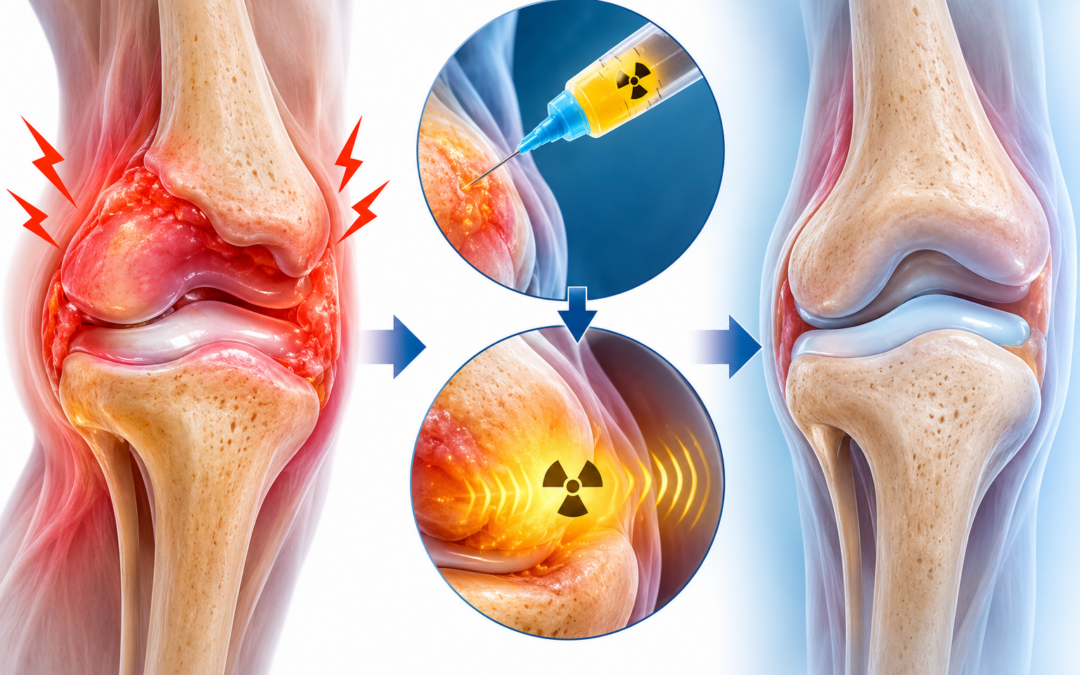
Radiosynovectomy, also called radiation synovectomy, is a minimally invasive day-care procedure for a joint that just won’t settle. Tablets haven’t worked. Steroid injections wore off. The swelling keeps coming back. A small amount of radioactive liquid is injected into the joint, and its radiation calms the inflamed lining where the trouble starts. Knees, elbows, ankles and even finger joints can be treated. Relief isn’t quick, though. It tends to build over a few weeks.
According to Dr. Gayana Shankaramurthy, a Nuclear Medicine Specialist in Bangalore at KIMS Hospitals, most patients expect relief within days. “It’s slower than that,” she says. “Pain usually eases over several weeks, and the first two days can actually feel a little worse.”
What Is Radiosynovectomy and How Does It Work?
Every joint has a thin lining called the synovium. In long-standing conditions like rheumatoid arthritis, that lining stays inflamed. It thickens, makes extra fluid and keeps the joint sore and puffy. Radiosynovectomy, sometimes called radiosynoviorthesis, goes straight at it. A radioactive colloid that gives off beta rays is injected into the joint. Cells in the inflamed lining absorb the particles. Over the next few weeks the radiation scars the lining slightly, and the swelling and fluid production drop. Beta rays only travel a short distance, so cartilage and bone get far less of the dose.
|
Joint size |
Isotope used |
Usual joints |
|
Large |
Yttrium-90 |
Knee |
|
Medium |
Rhenium-186 |
Elbow, ankle, shoulder, hip, wrist |
|
Small |
Erbium-169 |
Finger and toe joints |
The doctor picks the isotope to suit the joint. You can read more about the procedure on the Radiosynovectomy service page.
Living with a joint that stays swollen despite treatment? Book a consultation to find out if radiosynovectomy could help.
Who Can Have Radiosynovectomy, and What Are the Risks?
Doctors usually think of it when a joint has stayed inflamed despite medicines and steroid injections. Rheumatoid arthritis is the commonest reason. Others include repeated bleeding into the joints in hemophilia, psoriatic arthritis, ankylosing spondylitis, juvenile arthritis, and swelling that returns after joint surgery. A few people with osteoarthritis qualify too, if the lining is clearly inflamed.
Outcomes vary by condition. Overall, about 65% to 80% of patients improve, and hemophilia does best at around 80% to 85%. Osteoarthritis is less predictable, at roughly 40% to 56%.
Temporary flare. Pain and swelling can go up for a few days. This happens in roughly 40% to 50% of patients.
Leakage. Sometimes the liquid escapes the joint and irritates nearby tissue. It’s rare, and guided injection keeps the risk low.
Infection. Joint infection after the injection is very rare.
Long term. No confirmed rise in cancer risk has been reported. Where the cartilage is badly worn, doctors take extra care because bone can be affected.
Some people shouldn’t have it at all. That includes anyone who’s pregnant or breastfeeding, has an infection in or around the joint, or has a ruptured Baker’s cyst. Very recent joint surgery is another reason to wait.
What Determines Whether Radiosynovectomy Suits a Patient?
Radiosynovectomy is a procedure in which a small amount of radioactive medicine is injected into an inflamed joint to calm the lining and ease pain. The doctor starts with a few questions to see if it suits the patient. How long has the joint been inflamed, and what’s been tried? Does an ultrasound or scan show inflamed lining, or only worn cartilage? How big is the joint, since that sets the isotope and dose? Is there any infection, pregnancy or recent joint procedure that rules it out? If the answers fit, treatment can go ahead. If they don’t, there are other options to discuss
Key Takeaways
- Radiosynovectomy treats a chronically inflamed joint lining with a small radioactive injection.
- It’s considered when medicines and steroid injections haven’t settled the joint.
- Mild soreness for a few days is common. Real relief usually builds over three to four weeks.
- Pregnancy, breastfeeding, joint infection and a ruptured Baker’s cyst rule it out.
- Joint size and the underlying condition decide the isotope,so treatment is individualized for each patient.
Frequently Asked Questions
Is radiosynovectomy painful?
The joint is numbed first. Mild soreness for two or three days is common.
How long before radiosynovectomy relieves joint pain?
Most people notice it around three to four weeks after the injection.
Can radiosynovectomy be repeated?
Yes. If symptoms come back, the doctor can repeat it.
Who should not have radiosynovectomy?
Pregnant or breastfeeding women, and anyone with a joint infection or ruptured Baker’s cyst.
References:
- Review of radiosynoviorthesis (radiosynovectomy) in rheumatology. National Institutes of Health, PMC. https://pmc.ncbi.nlm.nih.gov/articles/PMC4579679/ (title and authors unconfirmed, verify before publishing)
- Radiosynovectomy article, World Journal of Nuclear Medicine 2015;14(1):10-15. https://doi.org/10.4103/1450-1147.150509 (title and authors unconfirmed, verify before publishing)
Disclaimer:This blog is for educational purposes only and isn’t a substitute for professional medical advice.