
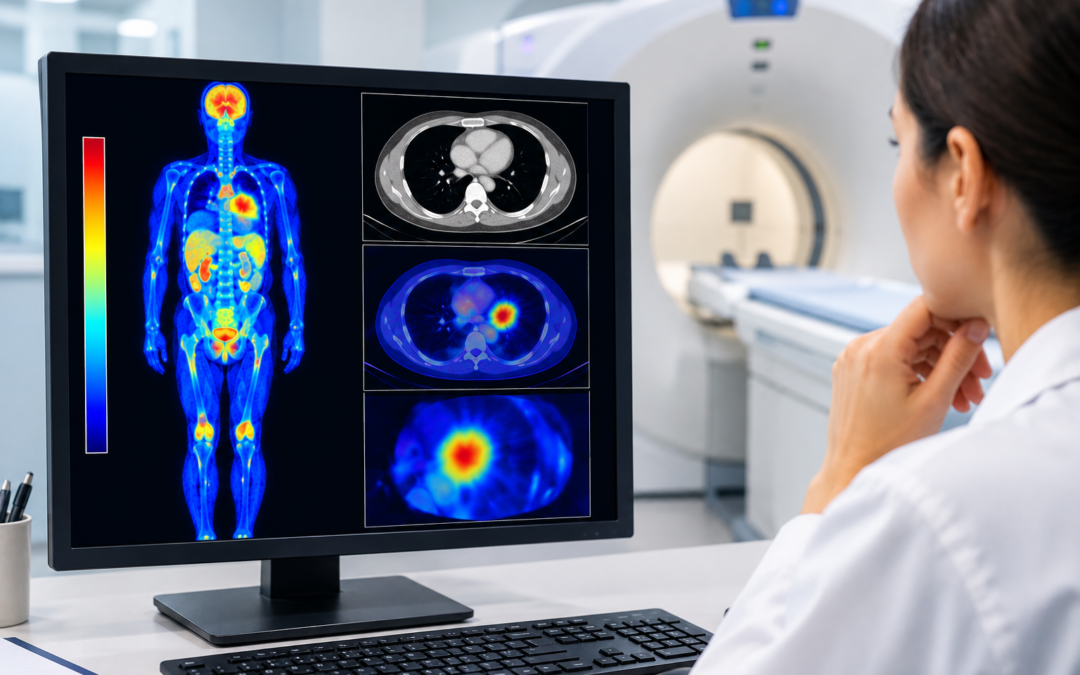
A PET scan result comes down to measuring how much sugar different tissues in your body are pulling in, since cells working in overdrive, like cancer cells, tend to burn through noticeably more of it than normal ones. The SUV value PET scan reports is simply the number attached to that measurement, a way of putting a figure on how brightly a particular spot lit up after absorbing the tracer. Higher numbers generally point toward more metabolically active tissue, though a high reading on your PET scan results isn’t automatically a cancer diagnosis by itself.
According to Dr. Gayana Shankaramurthy, an expert Nuclear Medicine Specialist at KIMS Hospitals, Bengaluru, patients often try to interpret their report on their own and end up more confused than before. A single number or line on the page rarely tells the full story by itself. “We don’t diagnose based on one detail in isolation,” she says. “It’s the full picture, the pattern, the location, and how it compares to what’s normal for that patient, that helps us understand what the findings may mean.”
What Does an SUV Value Actually Measure?
SUV numbers get thrown around like a diagnosis, but they’re really just a starting point for a much bigger conversation.
|
SUV Range (Rough Guide) |
General Interpretation |
|
Below 2.5 |
Often benign or inflammatory, but not conclusive |
|
2.5 to 5 |
Indeterminate, needs correlation with location and history |
|
Above 5 |
More frequently associated with malignancy, still not definitive alone |
These ranges are only a starting reference, not a diagnostic cutoff. Infection, inflammation, and even normal high-metabolism organs like the brain or heart can post high SUV numbers without any cancer involved at all. This is exactly why SUV values get read alongside imaging from a full PET/CT (Oncological & Non-Oncological) study rather than as a standalone score.
Holding a PET scan report and unsure what the numbers mean?
How Should You Read the Rest of Your PET Scan Report?
The SUV number is one line in a much longer document, and the rest of it carries just as much weight.
Location and shape matter enormously. A hot spot sitting exactly where a known tumor is expected behaves very differently from an unexpected finding somewhere unrelated.
Comparison over time often tells the real story for patients already in treatment. A dropping SUV across follow-up scans usually signals the treatment is working, even if the number hasn’t hit zero.
Background organ uptake gets factored in too. The liver, brain, and bladder naturally run hotter than most tissue, so radiologists compare suspicious spots against these known baselines rather than judging them in isolation.
False positives happen more than people expect. Recent infections, healing wounds, and even brown fat activation from being cold during the scan can all light up on the images.
If you’re trying to understand the bigger picture before diving into report specifics, it helps to start with what a whole-body PET scan detects.
Why Choose Dr. Gayana Shankaramurthy for Reading Your PET Scan Results?
Dr. Gayana Shankaramurthy is Director, Nuclear Medicine and Theranostics at KIMS Hospitals, Bengaluru, with 12 years of experience and more than 40,000 PET/CT scans interpreted personally. She holds an MD in Nuclear Medicine from PGIMER Chandigarh, along with FEBNM (Barcelona) and MICNM credentials, and has presented research at SNMMI and EANM. Every report is explained directly to the patient in plain language, not just handed over as a printout full of numbers. To discuss your PET scan results and understand what they mean, call 7483160232.
Frequently Asked Questions
Does a high SUV always mean cancer?
No, infection and inflammation can also raise SUV numbers.
What is a normal SUV value?
There isn’t one fixed number; it depends on the tissue type.
Can SUV values go down after treatment?
Yes, a falling SUV often indicates the treatment is working.
Should I read my own report before seeing my doctor?
You can, but context from your doctor prevents misreading it.
References:
- Kinahan PE, Fletcher JW. Positron emission tomography-computed tomography standardized uptake values in clinical practice and assessing response to therapy. National Institutes of Health, PMC. https://pmc.ncbi.nlm.nih.gov/articles/PMC3026294
- Weber WA, et al. Repeatability of SUV measurements in oncologic PET imaging. National Institutes of Health, PMC. https://pmc.ncbi.nlm.nih.gov/articles/PMC3795891
Disclaimer:This blog is for educational purposes only and isn’t a substitute for professional medical advice.