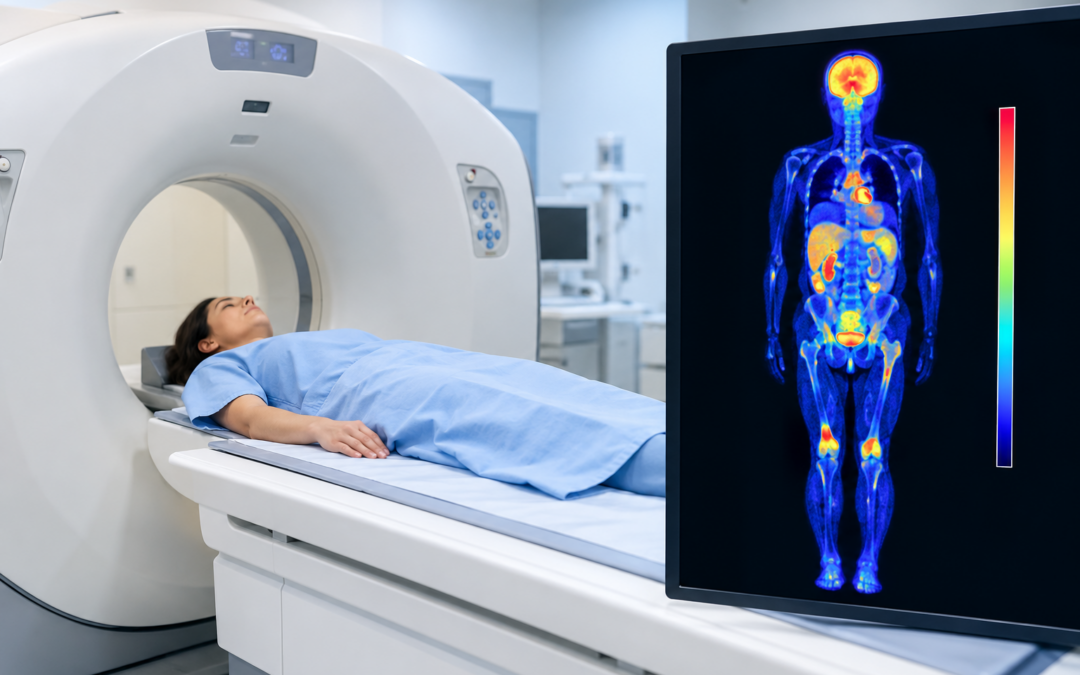
A whole body PET scan works by tracking where a mildly radioactive tracer usually a sugar compound called FDG collects once it’s injected into the bloodstream. Tissue with higher -than -normal metabolic activity, such as fast-dividing cancer cells or an area of active inflammation, draws in more of this tracer than surrounding healthy tissue, which makes it stand out clearly as a distinct spot on the scan.
According to Dr. Gayana Shankaramurthy, an expert Nuclear Medicine Specialist, “Patients are often surprised that a whole-body PET scan gives us one unified picture of the entire body lungs, liver, bones, lymph nodes rather than several separate scans stitched together. That’s what makes it so valuable for staging cancer accurately the first time.”
How Does a Whole-Body Scan Compare to a Single-Organ Scan?
Doctors don’t order a whole-body scan for everything it depends on the clinical question being asked.
|
Scan Type |
What It Shows |
Best Used For |
|
Whole-Body PET/CT |
Metabolic activity + anatomy, across the entire body |
Cancer staging, spread detection, treatment response |
|
Standard CT |
Detailed anatomy of one region |
Structural changes, injuries, organ size/shape |
|
MRI |
Soft tissue detail, one region at a time |
Brain, spine, joints, soft-tissue tumors |
|
Regional PET |
Metabolic activity in one body area |
Follow-up on a known, localized finding |
A regional scan is often enough once a condition is already localized. A whole-body scan becomes necessary the moment a doctor needs to know whether disease has spread beyond where it was first found this is where PET/CT (Oncological & Non-Oncological) imaging plays its biggest role.
Recommended a whole-body PET scan? Here’s what it actually looks for.
Which Organs and Conditions Does It Pick Up?
-
Lungs and chest. Lungs and chest. One of the most common reasons a whole-body PET scan is ordered is to evaluate lung nodules and determine whether a lung mass is metabolically active. It can also assess nearby lymph nodes for signs of spread.
Liver and abdomen. Metabolically active lesions in the liver, pancreas, or bowel often show up clearly, which is part of why the scan is used for colorectal and hepatobiliary cancers.
Bones and skeleton. Because the scan covers the entire skeleton in one pass, it catches bone metastases that a regional scan would simply miss.
Lymph nodes. Enlarged or hyperactive nodes anywhere in the body neck, chest, abdomen, groin are visible in the same session, which matters for accurate cancer staging.
Beyond cancer. Infections, unexplained fevers, and inflammatory conditions can also show up, since inflamed tissue is metabolically active too.
For patients specifically being evaluated for bowel cancer, we’ve covered this in more depth in our post on PET scan for colorectal cancer.
Why Choose Dr. Gayana Shankaramurthy for a Whole-Body PET Scan?
Dr. Gayana Shankaramurthy is Director, Nuclear Medicine and Theranostics at KIMS Hospitals, Bengaluru, with 12 years of experience and more than 40,000 PET/CT scans interpreted. She holds an MD in Nuclear Medicine from PGIMER Chandigarh, along with FEBNM (Barcelona) and MICNM credentials, and has presented research at SNMMI (USA) and EANM (Europe). Her approach pairs precise scan interpretation with clear communication, which can be particularly helpful for patients undergoing the test for the first time. Call 7483160232
Frequently Asked Questions
Is a whole-body PET scan painful?
No. Only a small injection is needed; the scan itself is painless.
Can it detect cancer before symptoms appear?
Yes, it often finds metabolically active disease before symptoms start.
Is the radiation exposure safe?
Yes, the tracer dose is small and leaves the body within hours.
How long does the full scan take?
Typically 20 to 60 minutes, plus about an hour of rest beforehand.
References:
- Canadian Agency for Drugs and Technologies in Health (CADTH). Positron Emission Tomography (PET) in Oncology: A Systematic Review of Clinical Effectiveness and Indications for Use. National Institutes of Health, PMC. https://pmc.ncbi.nlm.nih.gov/articles/PMC3411161
- The Rise of Total-Body PET/CT: Advancing Molecular Imaging Toward Early Cancer Detection. National Institutes of Health, PMC. https://www.ncbi.nlm.nih.gov/pmc/articles/PMC12786686/
Disclaimer: This blog is for educational purposes only and isn’t a substitute for professional medical advice.